

.png)

.png)


News ADEMS
.png)
"Eyeball" sharpening is becoming a thing of the past: why 2026 is the era of precision technology
Just a few years ago, a sharpening master could rely solely on personal experience, a keen eye, and a steady hand. Many clients chose a specialist through word of mouth, and the quality of work was assessed subjectively: "It cuts — so it must be good."
But the market is changing.
Today's customers have become far more demanding.
The modern market no longer wants promises — it demands predictable results.
In the past, minor deviations in sharpening angle were considered acceptable. Today, even small errors can reduce the quality and performance of a tool.
This is especially true for:
● Barber shears
● Manicure instruments
● Medical instruments
● Clipper blade sets
● Professional knives
Clients are increasingly noticing the difference between a tool sharpened "by eye" and one processed with modern technology.
The main trend of sharpening in 2026 — repeatability of results
One of the most important concepts in professional sharpening today is repeatability.
What does this mean?
If a master sharpens a tool today, in a month, and in six months — the quality must remain consistently good.
Not "roughly the same".
Not "almost the same".
But exactly the same.
For professional clients, this is critical:
● A barber doesn't want to keep readjusting to their shears after each service.
● A nail technician doesn't want to experience varying cut quality after every sharpening.
● Surgical instruments leave no room for inconsistency.
That is why more and more specialists are moving to equipment that allows them to control the process and eliminate the human factor.
Experience still matters — but it has limits
Of course, a master's experience remains important. But even the most skilled specialist is limited by human perception.
Fatigue, lighting, rushing, varying hand pressure — all these affect the final result.
Technology allows us to eliminate most of these factors.
Modern tool sharpening is built on three principles:
1. Angle control
Each tool requires a specific cutting edge geometry. Precise angle control ensures:
● High-quality cutting
● Longer tool life
● Comfort for the end user
2. Stability across the edge
It's not enough to hit the right angle — you must maintain it along the entire cutting edge.
3. Repeatability
Repeatability is what transforms sharpening from a craft into a technological process.
Customers are becoming more knowledgeable
Today's clients increasingly understand the value of quality sharpening.
For a nail technician, poorly sharpened nippers mean:
● Discomfort during work
● Wasted time
● Dissatisfied clients
For a barber, it means:
● Lower quality haircuts
● Increased strain on the hand
● Reduced shears lifespan
In manufacturing or the medical field, the cost of an error can be even higher.
That's why more customers are choosing professionals who can explain their technology and guarantee consistent results.
The sharpener's role is transforming
The profession of sharpener is also undergoing a major transformation.
In essence, the modern sharpener is becoming a specialist at the intersection of craftsmanship and engineering.
And it is precisely such professionals who will be in highest demand in the coming years.
The role of modern equipment
Achieving high precision sharpening without quality equipment is becoming increasingly difficult.
That is why professionals are increasingly turning to specialised sharpening machines that allow them to:
● Set the angle with precision
● Control the sharpening process
● Work with different types of tools
● Achieve stable results regardless of workload
On our website, you can find professional equipment that meets high standards of precision and reliability. Our company has been developing sharpening machines for barber, manicure, medical, household, and industrial tools for over a decade.
The core mission of our solutions is to provide masters with the engineering precision and repeatability that are becoming the key market requirements in 2026.
What lies ahead for the sharpening market?
Among the main trends for 2026, we can highlight:
● Rising quality standards
● The shift to professional equipment
● Growth in training and certification for sharpeners
● The increasing role of technology in the sharpening process
● Demand for guaranteed, predictable results
Conclusion
In 2026, sharpening is ceasing to be purely a craft and is increasingly becoming a technological process.
Customers are no longer willing to pay for results that depend on the master's mood or chance. They choose quality that can be repeated, again and again.
That is why the key concepts of the modern market are:
✔ Sharpening precision
✔ Repeatability of results
✔ Engineering accuracy
✔ Modern sharpening technology
Those who master these principles today will shape the market tomorrow. And modern equipment, combined with the right approach, will help make this transition faster and more confident.
More
.png)
Choosing your first sharpening machine: A practical guide for beginners
You’ve decided to learn sharpening. A useful craft — whether for your workshop, your home, or as a future business. But the first real question is often the hardest: Which sharpening machine should I buy?
Walk into any online store, and you’ll see dozens of options. Prices vary wildly. Marketing claims are loud. And it’s easy to make an expensive mistake.
This guide is not about selling you a specific brand. It’s about helping you think clearly before you buy. We’ll look at what actually matters for a beginner: the type of tools you’ll sharpen, why precision fixturing is critical, the tradeoffs between universal and specialised machines, and why longterm value and support matter more than a low price tag.
1. Start with one honest question: what will you actually sharpen?
Before comparing machines, answer this: Which tools will you sharpen most often?
Your answer determines the type of machine, the accessories you’ll need, and even the learning path. Here are three common profiles in the European market:
Profile
Typical tools
Potential customers
Recommended machine type
Beauty & grooming
Barber shears, texturising shears, clipper blades, manicure nippers
Salons, independent barbers, groomers, nail technicians
Specialised (Full Drive, GMT II)
Home & woodworking
Kitchen knives, chisels, plane irons, garden tools (secateurs, axes)
Home users, hobbyist woodworkers, allotment gardeners
Universal (Pro 2, Tesar)
Mixed / small workshop
Knives, scissors, medical instruments, woodworking tools
Small repair shops, multiservice workshops
Universal + one specialised accessory
A practical piece of advice: don’t try to do everything at once. Choose one or two areas where you already have an interest or where there’s steady demand. You can always expand later.
2. Why the fixturing system is the most important feature for a beginner
The biggest fear for anyone starting out: “What if I ruin an expensive tool?” And it’s a real risk. With freehand sharpening or cheap equipment, it’s very easy to change the angle, overheat the steel, or create a rounded, uneven edge.
The solution is a rigid fixturing system — a manipulator.
What is a manipulator?
A manipulator holds the tool securely and fixes the sharpening angle. You no longer have to “feel the angle” or hold it steady with your hands — the machine does that for you.
Without a manipulator (budget machines)
With a manipulator (professional machines)
The angle drifts as you work
The angle stays locked
Results depend on experience and fatigue
Results are repeatable, tool after tool
High risk of damaging expensive shears or knives
Risk is minimal, even for a beginner
Requires years of practice
Requires a few days of training
For a beginner, this is critical. A good manipulator turns sharpening from a gamble into a predictable process. You don’t guess — you follow a simple workflow.
3. Universal vs specialised: what makes sense at the start?
This is one of the most common questions. Let’s break it down for the European market, where space is often limited and every investment needs to be justified.
Universal machine (e.g. Pro 2, Tesar)
Advantages:
● One machine covers 80–90% of common tasks (knives, scissors, chisels)
● Lower initial investment
● Easier to learn basic sharpening skills
Disadvantages:
● May not handle complex tools (convex shears, fine texturising shears)
● Not ideal for niche tasks (manicure nippers, medical instruments)
Specialised machine (e.g. Full Drive, GMT II, Front Plate)
Advantages:
● Perfect results for a specific type of tool
● Higher speed and productivity
● Allows you to take on complex, highervalue jobs (convex shears, lefthanded scissors)
Disadvantages:
● Higher initial cost (you may eventually need several machines for different niches)
● Less flexible if you want to change your focus later
What should a beginner choose?
If you already know your niche — for example, you’re a barber who wants to maintain your own shears, or a nail technician — start with a specialised machine (Full Drive or GMT II).
If you’re still exploring and want to find what suits you best — begin with a universal machine (Pro 2 or Tesar). It will allow you to try different types of sharpening before making a more specialised investment.
If budget allows and you’re confident about your direction — a universal + specialised combination is the most efficient, but that’s for users who already have a clear business plan.
4. Why price is not the most important factor (and what matters instead)
In the European market, buyers tend to look at total cost of ownership, not just the purchase price. A cheap machine often turns out to be very expensive in the long run.
What happens with a lowquality machine?
Problem
Consequence
Shaft runout, play in the manipulator
Impossible to achieve a precise angle; uneven sharpening
Motor overheating under sustained use
Constant interruptions, low productivity
No speed control
High risk of overheating and ruining expensive steel
No training or support
You’re left to learn through trial and error
Difficult to find consumables
The machine becomes useless when abrasives wear out
What to look for instead
● A solid warranty (at least 12 months, preferably extended motor warranty)
● Training and support (video courses, inperson classes, aftersales help)
● Availability of consumables (abrasives, discs, pastes — easily orderable)
● Brand reputation (reviews from real users, company history)
A good machine pays for itself within 1–3 months of active use. A cheap one will lose you money — in ruined tools, lost customers, and wasted time.
5. Overview of ADEMS solutions for beginners
ADEMS offers several models that work well for beginners. Below is a neutral, factbased overview.
More

World‑Class Masterclass Brings Together Sharpening Industry Leaders
From September 21 to 25, 2026, an exclusive masterclass with Jean‑Paul Babin — a globally recognised sharpening master — will take place in Tours, France. This event brings together the CXPro and ADEMS International Academies under the shared motto: “Success Beyond Your Limits.”
Jean‑Paul Babin is a name known far beyond France. His unique methods have earned him recognition even in Japan, where knowledge of blade geometry is held in the highest regard. This is a rare opportunity to learn from a practitioner whose approach combines deep craftsmanship philosophy, technical excellence, and business insight.
The masterclass programme goes far beyond sharpening:
Technical Mastery: In‑depth study of geometry, working with complex instruments, and refining skills to benchmark level.
Leadership & Business: Building a reputation as the go‑to expert, customer focus, and strategies for growth and scaling.
Personal Development: Mindset training, breaking through the skill “ceiling” and unlocking your full potential.
This is a long‑term, measurable partnership with ongoing support. You become part of a global community of masters united by a commitment to quality.
“Our goal is to help you move beyond ‘good enough’ and become the benchmark. Excellence is not an option — it’s a habit.”
Who is this masterclass for?
Owners and managers of sharpening studios and service centres
Craftsmen aiming to reach an international level
Professionals working with barber, grooming, and medical instruments who want to master the most advanced techniques
Participation is fee‑based, and places are limited.
We are confident that the knowledge gained at this masterclass will help our clients and partners reach new heights in their craft. Stay tuned for more updates!
From September 21 to 25, 2026, an exclusive masterclass with Jean‑Paul Babin — a globally recognised sharpening master — will take place in Tours, France. This event brings together the CXPro and ADEMS International Academies under the shared motto: “Success Beyond Your Limits.”
Jean‑Paul Babin is a name known far beyond France. His unique methods have earned him recognition even in Japan, where knowledge of blade geometry is held in the highest regard. This is a rare opportunity to learn from a practitioner whose approach combines deep craftsmanship philosophy, technical excellence, and business insight.
The masterclass programme goes far beyond sharpening:
Technical Mastery: In‑depth study of geometry, working with complex instruments, and refining skills to benchmark level.
Leadership & Business: Building a reputation as the go‑to expert, customer focus, and strategies for growth and scaling.
Personal Development: Mindset training, breaking through the skill “ceiling” and unlocking your full potential.
This is a long‑term, measurable partnership with ongoing support. You become part of a global community of masters united by a commitment to quality.
“Our goal is to help you move beyond ‘good enough’ and become the benchmark. Excellence is not an option — it’s a habit.”
Who is this masterclass for?
Owners and managers of sharpening studios and service centres
Craftsmen aiming to reach an international level
Professionals working with barber, grooming, and medical instruments who want to master the most advanced techniques
Participation is fee‑based, and places are limited.
We are confident that the knowledge gained at this masterclass will help our clients and partners reach new heights in their craft. Stay tuned for more updates!
More
Jean‑Paul Babin is a name known far beyond France. His unique methods have earned him recognition even in Japan, where knowledge of blade geometry is held in the highest regard. This is a rare opportunity to learn from a practitioner whose approach combines deep craftsmanship philosophy, technical excellence, and business insight.
The masterclass programme goes far beyond sharpening:
Technical Mastery: In‑depth study of geometry, working with complex instruments, and refining skills to benchmark level.
Leadership & Business: Building a reputation as the go‑to expert, customer focus, and strategies for growth and scaling.
Personal Development: Mindset training, breaking through the skill “ceiling” and unlocking your full potential.
This is a long‑term, measurable partnership with ongoing support. You become part of a global community of masters united by a commitment to quality.
“Our goal is to help you move beyond ‘good enough’ and become the benchmark. Excellence is not an option — it’s a habit.”
Who is this masterclass for?
Owners and managers of sharpening studios and service centres
Craftsmen aiming to reach an international level
Professionals working with barber, grooming, and medical instruments who want to master the most advanced techniques
Participation is fee‑based, and places are limited.
We are confident that the knowledge gained at this masterclass will help our clients and partners reach new heights in their craft. Stay tuned for more updates!
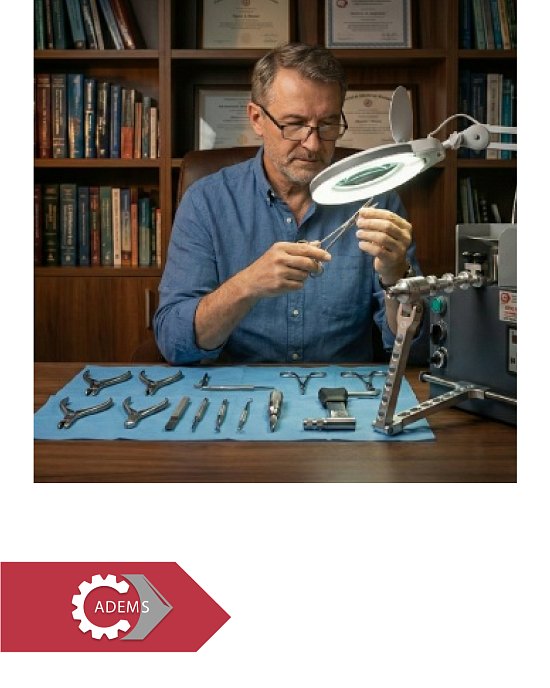
Sharpening Medical and Dental Instruments: Why Precision Is Non-Negotiable
ADEMS International — Professional sharpening equipment · 7 min read
Sharpening a surgical instrument is not simply restoring a cutting edge. It is a question of patient safety, surgical outcomes, and the reputation of a medical facility. A dull or incorrectly sharpened scalpel, curette, or surgical scissors can cause tissue trauma, extend procedure time, and compromise the quality of care.
Unlike sharpening a kitchen knife at home, working with medical instruments demands a completely different level of attention, control, and equipment. Here is what every professional sharpener — and every clinic manager — should understand.
1. Which medical instruments require regular sharpening
The range of medical instruments that need periodic sharpening is wider than most people expect.
Category
Examples
General surgery
Scalpels (belly, pointed tip, ophthalmic), amputation knives, surgical scissors
Dental & periodontal
Curettes, scalers, excavators, chisels, laryngeal knives
Microsurgery
Microsurgical scissors, atraumatic-tip forceps, ophthalmic scalpels
Specialist tools
Coagulators, clamps, trephines, cystotomes
2. How medical sharpening differs from everyday sharpening
Microscope-level quality control
Edge geometry and surface roughness must be verified under magnification. Visual assessment alone is simply not acceptable here — the margin for error is zero.
Rigid fixation and exact angle calibration
Freehand sharpening — even by an experienced professional — introduces variation that is unacceptable in a clinical context. The instrument must be locked in position and the angle set mechanically.
Heat control
Overheating during sharpening destroys the temper of surgical steel. A single careless pass can render an expensive instrument permanently unusable.
Repeatability across instruments
In a clinical setting, the same result must be delivered every time — not occasionally. A system, not a skill, is what guarantees this.
3. The geometry challenge: curettes and scalers
Dental instruments — curettes and scalers in particular — present a specific geometric challenge that sets them apart from most other instruments.
Their working ends are curved, and sharpening must restore the cutting edge without altering the curvature radius or flattening any of the instrument's faces. This requires both the right abrasive and a controlled, stable sharpening motion. Any deviation changes the instrument's behaviour at the treatment site.
Common mistake: using a flat stone on a curved working end. The result looks sharp under normal light — but the curvature has shifted, and the instrument no longer performs as designed inside the periodontal pocket.
4. How ADEMS equipment meets medical-grade standards
4.1 Precision and repeatability
ADEMS machines are built around a core principle: the result must not depend on how experienced the operator is that day. Instrument fixation, angle setting, and abrasive pressure are all controlled mechanically — not by feel.
ADEMS Full Drive
Full-featured platform for professional sharpening studios. Handles a wide range of medical instruments with consistent results.
ADEMS Med
Specialist models designed with medical instrument geometry in mind. Compact and precise.
ADEMS GMT
Series
Versatile range suitable for both clinical facilities and independent sharpening professionals working with medical tools.
ADEMS ASAB System
Rapid abrasive change in seconds. Medical workflows often require multiple abrasive types across a single sharpening session — ASAB removes the bottleneck.
4.2 The ASAB abrasive system
Medical sharpening typically involves several stages: coarse material removal, fine edge refinement, and polishing. Each stage requires a different abrasive. The ADEMS ASAB quick-change system switches between wheels in seconds — keeping the workflow clean, fast, and consistent.
Sharpening medical instruments is precision manufacturing — not a service.
It carries direct responsibility for the safety of patients. Ignoring edge geometry standards, overheating the metal, or using the wrong abrasive turns an expensive surgical instrument into a source of risk. The equipment used must match the standard that medicine demands.
Who this applies to
If you manage a surgical centre, dental practice, or medical equipment maintenance service — understanding what proper instrument sharpening requires is part of your quality standard. And if you are a professional sharpener looking to add medical instruments to your offering, this is a high-value, underserved niche with very few qualified competitors.
Ready to work to medical-grade standards? Our specialists will help you identify the right equipment for your instruments and workflow.
Talk to a specialist ↗
More
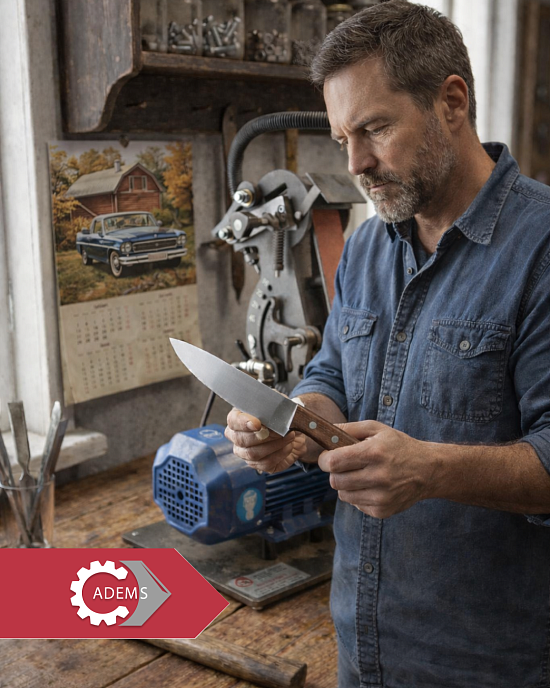
Sharpening as a Hobby: Why It Calms Better Than a Therapist
Men's Meditation: The Art of Restoring Sharpness
In a world where notifications attack with the speed of bullets in an action game, true luxury becomes silence. Not the silence of muting your phone, but the silence that descends when your hands are engaged in a monotonous task demanding complete focus.
For some, the escape is the gym; for others, it's fishing. But there is an ancient, almost sacred masculine pursuit that combines practical benefit with deep relaxation: the art of sharpening blades.
Winston Churchill, a renowned connoisseur of leisure, once wrote: "It is no use arguing with a mind that is in a state of excitement. One can only gently insinuate something else into its convulsive grasp. And if the something else is rightly chosen, if it is attended by the illumination of another field of interest, gradually, and often quite swiftly, the excessive tension is relaxed and the process of renewing and restoring the healthy mind is accomplished."
Sharpening fits this description perfectly. It's not merely a household chore; it's a genuine conversation with metal.
Why Sharpening Soothes the Nerves
When you guide a blade across a stone, the world narrows to a single point: the edge of the steel. You stop thinking about reports, deadlines, or that call you need to make. Only one thing remains – the dialogue between steel and stone.
As one enthusiast reflected on the nature of this pastime: "I've encountered countless methods of sharpening, each one claimed to be the one true way. Observing the process closely, I began to understand: it's probably not so much about the method itself, but about the character of the person. For many, it's not the result that matters most, but the process. Sharpening is a form of meditation – a way for the mind to relax by concentrating on a single, repetitive action with a consistent rhythm."
The sound the stone makes under the blade changes as you progress. On a coarse stone, it's a hiss; on a fine one, it's a whisper. An hour passes like five minutes.
From Hobby to Mastery
Many start with a simple desire to tidy up their kitchen knives. But the process is captivating. At first, you just want the knife to cut; then you want it to cut perfectly. Eventually, you realize the process itself brings as much pleasure as the result.
When you draw the blade across a sheet of paper after sharpening, and it parts into two perfect halves under its own weight, you experience a satisfaction comparable to solving a complex puzzle.
This hobby doesn't demand huge investment, but it offers something money can't buy: a sense of control, completion, and order. In a world where we rarely see the immediate results of our labour, sharpening provides instant feedback: it was dull – now it's sharp.
Tools for the Soul
For true immersion in the process, skill alone isn't enough; you need the right tools. When your hands feel quality abrasives, when the machine doesn't vibrate or hum, when every mechanism moves smoothly – that's when you achieve that state of flow.
Modern equipment from ADEMS International allows you not just to sharpen, but to derive genuine pleasure from the process. Precise angle adjustment, the smooth glide of the manipulator, thoughtful ergonomics – all of this removes distractions, leaving only the dialogue between man and steel. You're not fighting the tool – you're creating.
What You Need for Soulful Sharpening
If you're just exploring this hobby, you don't need to buy a professional arsenal right away. You can start small:
For true immersion, you need:
● Silence in your workshop or garage
● Good lighting
● A comfortable chair or stool
● Quality abrasives
● A tool you don't mind trying for the first time
Many men admit that after a hard day's work, an hour of sharpening restores them better than any sleeping pill. It's time when you belong only to yourself.
When a Hobby Grows into Something More
The passion for sharpening has an interesting characteristic: it develops subtly. First, you sharpen kitchen knives for your family. Then a neighbour asks if you could touch up their secateurs. Later, a friend brings over their hunting knife.
This way, a hobby can become a source of extra income. But it's not really about the money. It's about recognition. When someone picks up a tool you've sharpened and says, "It works better than new," – that's priceless.
The Masculine Stress Relief: The Science of the Process
Psychologists confirm that monotonous actions with intense focus on a single task are one of the best ways to relieve stress. Methods like "5-4-3-2-1" suggest focusing on external sensations, but sharpening offers something more: you're not just observing – you're creating.
Working with metal demands:
● Complete concentration
● Measured, deliberate movements
● Patience
● An understanding of the physics involved
This is precisely what the information-overloaded mind of the modern man needs.
Conclusion: A Sharp Blade – A Sharp Mind
Returning to Churchill: "Hobbies were considered an important means of enriching every part of a man's life. They can bring joy, increase your attention, keep the mind sharp, enhance creativity, help you meet people, and teach you valuable skills. In short, hobbies add interest to life and help you become a more rounded person."
Knife sharpening as a hobby offers a rare commodity in today's world: an immediate and tangible result from your efforts. In an age of virtual victories and digital achievements, returning to something simple and timeless – to steel, to stone, to sharpness – is a way to return to your authentic self.
Try it sometime. Take a dull blade and restore it to perfection. You might discover not just a new hobby, but a way to find your balance every day. Literally and figuratively.
ADEMS International – your space of silence and order. Equipment for those who value quality tools and the authentic process.
Short version for social media:
In a noisy world, real silence is a luxury. An hour in the workshop with a blade and a stone – no notifications, no deadlines. Just you, the steel, and the rhythm of sharpening. It's not a chore, it's meditation. ADEMS International – tools for the soul.
More
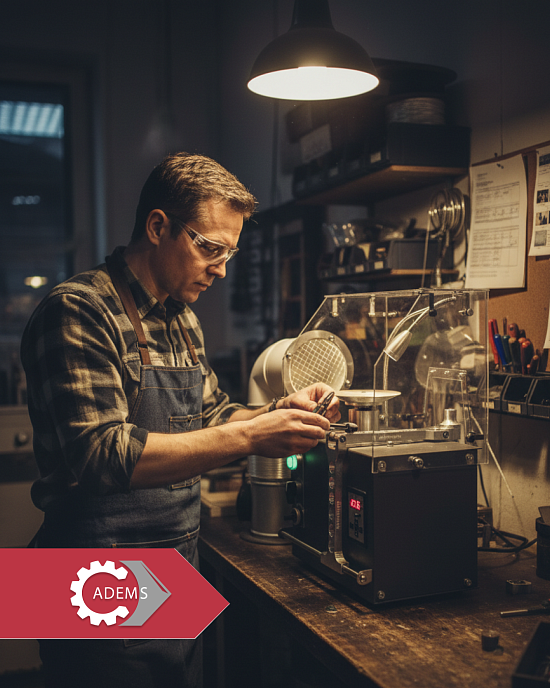
ADEMS Full Drive: Professional Sharpening Machine for Hairdressing Tools
A Classic in Its Genre: Where Precision Meets Technology
Dull scissors are not just an inconvenience for a hairdresser. They mean lost clients, a damaged reputation, and physical fatigue from having to exert excessive force with every cut. The ADEMS Full Drive sharpening machine for hairdressing tools is designed to restore factory sharpness to your scissors and extend their service life for years.
In an era where service quality determines a salon's success, professional equipment for tool maintenance becomes not a luxury, but a necessity. The Full Drive is an investment that pays off, transforming dependence on third-party sharpeners into complete autonomy.
Why Hairdressers Choose ADEMS Full Drive
The Problem the Machine Solves
Traditional methods of sharpening hairdressing scissors:
● Manual sharpening — requires years of experience, risk of ruining expensive tools.
● Sharpening services — high cost (800-2000 rubles per pair), dependence on the sharpener's schedule, downtime.
● Budget machines — uneven sharpening, metal overheating, short service life.
● ADEMS Full Drive — professional results, complete control, cost savings.
Who This Machine is For
The ideal solution for:
● Salon owners — ROI within 2-3 months with 3+ stylists on staff.
● Practicing hairdressers — independence from sharpening workshops.
● Barbershops — daily scissor use requires regular maintenance.
● Training centers — teaching students to work with professional equipment.
● Sharpening workshops — expanding service offerings, increasing productivity.
Technical Specifications of ADEMS Full Drive
Characteristic
Value
Advantage
Drive Type
Direct electric
No vibration, precise positioning
Rotation Speed
1400-2800 rpm (adjustable)
Works with any steel type without overheating
Wheel Diameter
150 mm
Optimal contact area
Wheel Grit
180-3000 (replaceable)
From restoration to polishing
Power
120 W
Energy efficient with high productivity
Weight
12.5 kg
Stability during operation
Dimensions
420×280×320 mm
Compact for workshop placement
Clamping and Positioning System
Double-jointed manipulator:
✓ Adjustable sharpening angle
✓ Reliable blade fixation
✓ Precise positioning accuracy
Professional-Grade Ergonomics
Thought-out details:
● Non-slip base — rubber feet dampen residual vibrations
● Work area lighting — for quality control
● Ergonomic handles — tool-free adjustment
Additional Benefits
Intangible advantages:
✓ Independence — sharpen anytime, at your convenience
✓ Speed — scissors ready in 30 minutes, not a week
✓ Quality control — you are responsible for the result
✓ Staff training — enhancing the skills of your team
✓ Additional income — the opportunity to offer services to other salons
Conclusion: ADEMS Full Drive — A professional solution with maximum functionality and reliability.
Frequently Asked Questions (FAQ)
About the Machine's Capabilities
Q: Can I sharpen only hairdressing scissors?
A: No, the Full Drive is suitable for sharpening:
● Manicure scissors
● Clipper blades
● Scalpels
● Knives
About Purchase and Delivery
Q: Are installment payment options available?
A: Yes, various payment and delivery options are available.
Conclusion: An Investment in Professionalism
The ADEMS Full Drive sharpening machine for hairdressing tools is not just equipment; it's a tool that transforms your approach to work.
Why ADEMS Full Drive is the Right Choice
● Economic benefit — rapid return on investment
● Independence — sharpen anytime, no waiting for a technician
● Quality and reliability — professional results comparable to the best sharpeners
● Versatility — works with all types of hairdressing scissors
● Growth — a new skill that enhances your value as a specialist
Who We Especially Recommend ADEMS Full Drive For
Essential for:
• Beauty salons with 3+ stylists
• High-volume barbershops
• Sharpening workshops (expanding services)
• Training centers
Excellent solution for:
• Freelance hairdressers
• Beginner sharpeners
• Perfectionists who value an impeccable tool
The Next Step
Sharp scissors are not a luxury, but a basic requirement of the profession. A dull tool steals your time, energy, and reputation.
ADEMS Full Drive gives you back control over the quality of your work.
ADEMS — professional equipment for those who don't compromise.
More
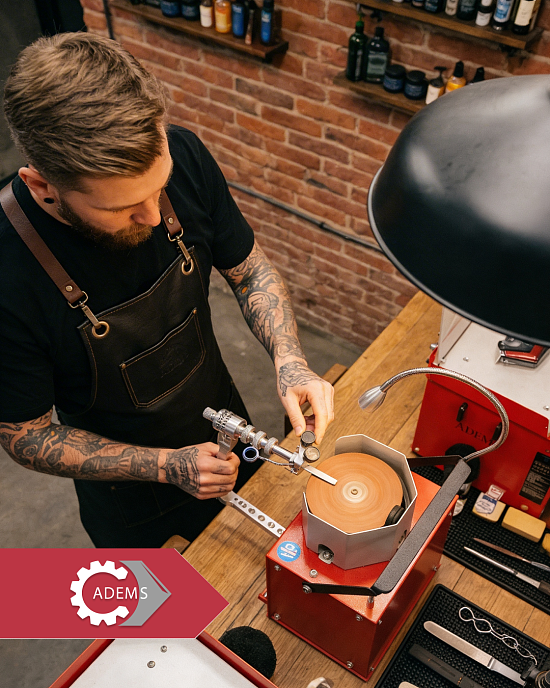
A Gentleman's Set: What Sharpening Tools Every Man Should Have at Home
A Gentleman's Workshop: Where Order Meets Craftsmanship
Sharpening knives is not just a household necessity. It is a ritual requiring focus, precision, and the right tools. A real man understands: a quality sharpening set is just as essential a part of the home arsenal as a good suit in the wardrobe or a collection of fine whiskey in the bar.
In an era when more and more men are returning to conscious consumption and value things made to last, a sharpening machine becomes not just a utilitarian device, but a symbol of order, self-sufficiency, and respect for one's tools.
Why a Sharpening Set is More Than Just a Tool
The Philosophy of a Sharp Blade
A dull knife in the kitchen is not only an inconvenience but also a sign of disrespect for the cooking process. A sharp blade transforms routine cooking into a meditative act, where every cut is precise and the outcome predictable.
Sharpening tools in a modern man's home represent:
• An element of personal style — a reflection of attention to detail.
• Practicality — saving on professional sharpening services.
• Independence — the ability to sharpen a tool anytime.
• A therapeutic effect — the sharpening process as a form of meditation.
Men's Home Accessories: A New Aesthetic of Functionality
The days when a man's space was limited to a garage with tools scattered haphazardly are over. The modern approach is thoughtful organization, where every item has its place, and functionality is combined with aesthetics.
New-generation men's home accessories include:
• Sharpening machines with minimalist design.
• Sets of sharpening stones in wooden cases.
• Organizers for storing sharpening equipment.
These items aren't hidden away in a drawer; they become part of the interior of a workshop, study, or even the kitchen.
What You Need for Sharpening: The Essential Gentleman's Set
ADEMS Tesar
If you are just starting to build your sharpening kit, begin with the basics:
We have gathered everything you need in a ready-made kit: A set for sharpening household tools
Sharpening Tools: How to Choose Based on Your Needs
Define Your Usage Profile
For the kitchen, for hobbies and collecting:
• Focus on speed and convenience.
• Suitable: An electric sharpening machine.
• Result: Sharp knives in 5-10 minutes.
For the workshop, consider:
• Versatility and a wide range of tasks.
• Suitable: A professional machine + hand stones + diamond stones.
• Result: The ability to sharpen any tool.
Organizing a Man's Space: Where to Store Your Sharpening Set
Principles of Proper Storage
What do you need for sharpening besides the tools themselves? Proper space organization:
Consider wall-mounted organizers with mounts, a work surface with non-slip coating, and an exhaust hood. Good lighting for the sharpening area is, of course, very important.
The Aesthetics of the Process
The modern approach to men's home accessories means the sharpening process becomes not just a technical procedure, but a kind of ritual:
• Preparing the workspace — cleaning the surface, preparation.
• Choosing musical accompaniment — jazz or classical for concentration.
• Proper lighting — natural or directed light.
• Finishing — cleaning tools, checking the result.
Sharpening Technique: Basic Principles a Gentleman Should Remember
1. The sharpening angle.
2. The direction of movement.
3. Checking sharpness.
Common Beginner Mistakes
❌ Excessive pressure — leads to uneven sharpening.
✅ Correct: Moderate, even force.
❌ Changing the angle during the process — creates a rolled edge.
✅ Correct: Using guides at the initial stage.
❌ Neglecting finishing — leaves burrs.
✅ Correct: Polishing on a fine-grit stone or machine.
Psychological Value
What sharpening provides in a psychological sense:
• Control — managing the process from start to finish.
• Mindfulness — concentration on the present moment.
• Mastery — visible progress in skill.
• Satisfaction — from the result of your own work.
This is an investment not only in tools but also in quality of life.
The Culture of Sharpening: Community and Skill Development
Where to Learn
Offline:
• Masterclasses in specialized schools.
• Courses from professional sharpeners.
• Knife enthusiast clubs.
Development from Hobby to Mastery
Stage 1: Mastering the Basics (Sharpening kitchen knives, Developing muscle memory).
Stage 2: Expanding Capabilities (Sharpening different types of blades, Mastering the full cycle from coarse sharpening to polishing, Experimenting with angles and techniques).
Stage 3: Mastery.
What to Check When Buying
Sharpening Machines:
• Smoothness of mechanism movement.
• Build quality (play, noise).
• Presence of overheating protection.
• Warranty obligations.
Sets:
• Completeness.
• Compliance with stated specifications.
• Manufacturer's reputation.
The Environmental Aspect
Sharpening vs. Replacement
Sharpening tools are a contribution to sustainable consumption:
Resource Savings:
• One knife lasts for decades instead of being replaced yearly.
• Reduction in production emissions.
• Less packaging material.
• Reduced transportation costs.
Philosophy:
• Shift from disposability to durability.
• Repair instead of replacement.
• Value of quality items.
• Passing tools down through generations.
A Sharpening Set as a Gift
Who It's For
Ideal recipients:
✓ Beginner cooks and culinary enthusiasts.
✓ Owners of country houses.
✓ Camping and outdoor enthusiasts.
✓ Knife collectors.
✓ Men who appreciate quality tools.
✓ Those who "already have everything."
Occasion:
• Birthday.
• Housewarming.
• Professional holiday.
• "Just because" for a loved one.
Conclusion: The Philosophy of a Sharp Blade
A sharpening set is more than just a collection of tools. It is:
• An investment in the quality of everyday life.
• A skill that will last a lifetime.
• A ritual that structures time.
• A philosophy of respect for the tool and the process.
• A style reflecting attention to detail.
Men's home accessories of the new era combine functionality, aesthetics, and meaning. A sharpening machine is not just a useful item, but an element of the modern gentleman's lifestyle.
Remember: what you ultimately need for sharpening is not just the right tools, but the right attitude. A sharp blade begins with the desire to bring order to your space, with respect for things and processes.
The Next Step
Ready to create your own gentleman's sharpening set? At adems-International.com , you will find carefully curated kits for every level — from basic solutions for beginners to professional equipment for perfectionists.
Sharpening tools from ADEMS are a guarantee of quality, European design, and attention to detail. Each set is assembled with the understanding that sharpening is not just a procedure, but part of the philosophy of a quality life.
• Link to the ADEMS sharpening machine catalog
ADEMS — men's home accessories where functionality meets aesthetics.
More
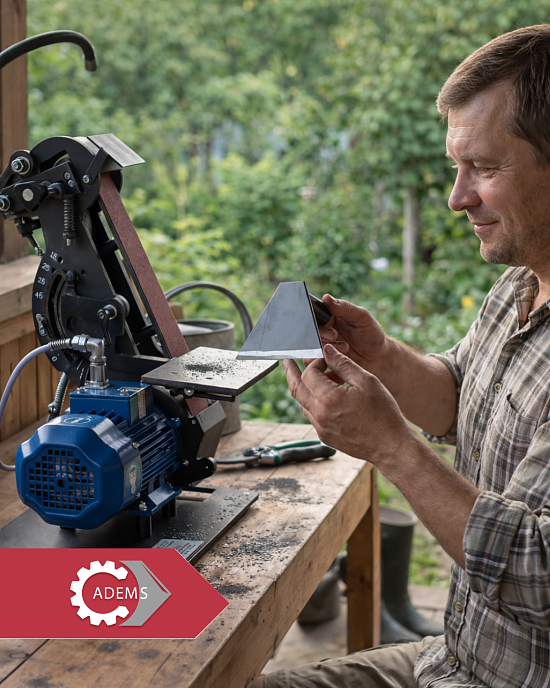
How to Prepare Your Garden Tools for the Season and Keep Your Plants Healthy
Getting your garden tools ready for spring – sharpening secateurs, shears, and tool maintenance with ADEMS
One dull pruner – and your entire garden is at risk.
In March, when snow still covers the ground, gardeners are already browsing plant catalogues, sketching out bed layouts, and mentally pruning the apple tree that ran wild last year. Plans are made for ten acres and two lifetimes ahead.
Then April arrives. You open the shed, take out your secateurs, squeeze the handles – and instead of a clean snip, you hear a crunch. The blades don't cut – they crush the branch, leaving a torn, splintered wound. Through this opening, fungal spores, bacteria, and viruses enter the plant's tissue. The tree starts to suffer. Not immediately – but in a month or two, by mid-summer. And the gardener blames the weather, the variety, the soil – anything but that dull pruner from the shed.
Preparing your garden tools for the season isn't optional. It's the first thing every gardener should do before touching a single branch. This guide is about doing it right: what to put in order, how to sharpen, what to lubricate, and when it's time to stop reviving and buy new.
Why Dull Tools Aren't Just Inconvenient – They're Dangerous for Your Garden
Before diving into instructions, let's understand the biology. This matters because grasping the consequences turns "well, I should probably sharpen it" into "I'm doing this right now."
What Happens to a Branch with a Clean Cut
A sharp pruner severs plant tissue cleanly. Cells at the cut edge remain intact. The cambium – the thin layer of growth cells beneath the bark – immediately begins its healing work. The wound closes with callus tissue (the plant equivalent of a scar) within days. Infection risk is minimal.
What Happens with a Ragged Cut
A dull blade doesn't cut – it crushes, mashes, and tears tissue. Fibers are splintered. The damage area increases three to five times compared to a clean cut. Cells around the wound are destroyed – the cambium has nothing to "grab onto," healing slows down.
Then comes the chain reaction:
● An open wound is an entry gate for infection. Spores of moniliosis, cytosporosis, black canker enter the tissue directly.
● Delayed healing means the wound stays wet, attracts pests, and starts to rot.
● Branch dieback – if damage is severe, the branch dries from the cut downwards. The gardener sees this in summer and wonders: "But I pruned correctly!"
● Systemic infection – through the ragged wound, infection enters the tree's vascular system. The result isn't one sick branch, but a sick tree.
The Scale of the Problem
During spring pruning of an average fruit garden (10-15 trees, shrubs, vines), a gardener makes between 200 and 500 cuts. If every one of them is ragged, the garden receives two to five hundred open wounds in a single day. That's not pruning – it's sabotage.
The bottom line: sharpening secateurs and garden shears isn't about the gardener's convenience. It's about plant health. Every ragged cut is a potential disease epicentre that could cost you a tree.
The Complete Checklist: What Tools Need Pre-Season Preparation
Garden tool maintenance starts with an audit. Take everything out, lay it on your workbench or table, and sort it.
Cutting Tools (Require Sharpening)
● Secateurs (Pruners) – the primary pruning tool. Almost every gardener has them, they're used most often, and they dull fastest.
● Loppers – secateurs on long handles for thick branches. Sharpening principle is the same.
● Garden Shears – for hedge trimming, shaping shrubs, topiary.
● Pruning Saw – for branches over 3 cm in diameter.
● Grafting / Budding Knife – for grafting, cleaning cuts, bark removal. Requires razor sharpness.
● Grass Shears – for lawn edges, borders, hard-to-reach spots.
Digging & Cultivating Tools (Require Sharpening & Dressing)
● Spade – yes, spades need sharpening too. A sharp spade enters the ground much more easily.
● Hoe – a dull hoe slides over the soil instead of cutting weeds.
● Axe – for chopping branches, preparing stakes, rough work.
● Scythe / Sickle – if you use them for mowing.
Auxiliary Tools (Require Maintenance, Not Sharpening)
● Rake – check tine attachment, straighten bent ones.
● Pitchfork – check handle and tines.
● Watering Cans, Sprayers – clean, check nozzles, replace washers.
● Wheelbarrow – lubricate the wheel, check fasteners.
Step-by-Step Guide: Preparing Your Garden Tools for Spring
Now for the specific algorithm. We'll go from general to specific: first, the basic maintenance that applies to any tool, then sharpening by category.
Step 1. Cleaning
Why: Over winter, tools accumulate dirt, dried plant sap, and rust. All this prevents you from assessing their true condition and clogs mechanisms.
How to do it:
1. Soak metal parts in warm water with dish soap for 20-30 minutes.
2. Remove dirt and dried sap with a stiff brush (a wire brush or Scotch-Brite pad works).
3. For rust removal, use sandpaper (grit 200-400) or a special rust converter.
4. Dry the tool completely. Moisture is enemy number one.
Pro tip: Dried tree sap is easily removed with alcohol or WD-40. Apply, wait a few minutes, wipe with a rag.
Step 2. Inspection and Diagnosis
What to look for:
● Blades – chips, dents, "waves" on the edge, significant wear. If the blade is worn down by more than a third of its original width – it's time to replace the tool.
● Secateur spring – is it loose or deformed? A weak spring means the pruner doesn't open fully, requiring extra effort.
● Pivot joint – play, sticking, wear. Play in the joint means the blades don't close tightly, leading to crushed branches instead of clean cuts.
● Handles – cracks, chips, loose fittings. Check wooden handles especially carefully: a crack in a spade or axe handle is a direct path to injury.
● Lock mechanism – does the latch that holds the pruner closed work?
Decision: Make two lists – "to sharpen" and "to replace." Tools with critical wear, cracks in the metal, or broken mechanisms aren't worth reviving – cheaper and safer to buy new.
Step 3. Sharpening
This is the main event. We'll break it down by tool type.
Sharpening Garden Tools: Basic Rules and Recommendations
Sharpening Secateurs
There are several types of secateurs, each with its own features. In most models, the main cutting blade does the work and needs sharpening. The other part of the mechanism serves as an anvil or support and should remain flat and smooth.
When sharpening, it's crucial to maintain the blade's original factory angle and not remove excess metal. Usually, carefully restoring the cutting edge and removing any burrs is sufficient.
Sharpening can be done manually with a whetstone or on a specialized machine. The manual method is fine for occasional maintenance of a single tool. But if you have several pruners or work regularly in the garden, a machine significantly speeds up the process and provides more accurate results.
Sharpening Garden Shears
Garden shears are used for trimming shrubs, hedges, and tending ornamental plants. Their long blades require especially even sharpening.
Unlike secateurs, both blades work, so it's important to maintain consistent sharpness along the entire cutting edge. After sharpening, the shears should close easily and evenly, without catching.
You can test sharpness simply: the tool should cleanly cut thin paper or soft shoots without ragged edges.
Sharpening Garden Knives
Garden knives are used for precise tasks – like grafting or cleaning bark damage.
These knives have particularly high sharpness requirements. The blade must be very fine and carefully honed to execute clean, precise cuts.
Do Spades and Hoes Need Sharpening?
Many gardeners don't think about sharpening these tools. But a sharp spade or hoe makes work significantly easier.
A well-sharpened spade enters the soil more easily, requiring less effort for digging. A hoe with a restored edge cuts weeds more effectively, allowing faster bed cultivation.
In most cases, simply restoring the working edge and removing damage is sufficient – you don't need a razor-sharp edge.
Manual Sharpening vs. Machine
For occasional maintenance of one or two tools, manual sharpening is fine. But if you have many tools or need regular care, a specialized sharpening machine is more convenient.
A machine allows you to:
● maintain a consistent sharpening angle
● work faster
● process the entire cutting edge evenly
● service different types of tools
Modern sharpening machines are manufactured by, for example, ADEMS International.
Such equipment helps achieve professional results and greatly simplifies garden tool maintenance.
Step 4. Rust Prevention and Preservation
After sharpening, each tool needs protection from corrosion. This takes five minutes but extends service life for years.
Metal Parts
● Wipe dry thoroughly.
● Apply a thin layer of protective oil (machine oil, gun oil, or special garden tool oil). WD-40 can be used, but note it's a water displacer, not a long-term protectant. For storage, camellia oil or food-grade mineral oil (if the tool contacts plants) is better.
● For long-term storage – wrap in an oiled rag.
Wooden Handles
● Sand smooth (240-320 grit).
● Soak with linseed oil (two or three coats, letting it dry between applications). Boiled linseed oil is a budget alternative, but raw linseed oil penetrates deeper and feels nicer.
● Do not varnish! Varnish creates a slippery film – the handle will slip in your hands.
Springs and Mechanisms
● Apply a drop of oil to every joint, spring, and adjustment screw.
● Work the mechanism a few times to distribute the oil.
Disinfection: What Almost Everyone Forgets
Here's another critically important step that even experienced gardeners miss.
Why Disinfect Garden Tools
Infection spreads from plant to plant via a pruner blade just as surely as it spreads from patient to patient via a non-sterile scalpel.
You prune a branch from an apple tree with fire blight. Bacteria remain on the blade. Your next cut is on a healthy pear tree. That's it – the pear is infected.
When Manual Sharpening Isn't Enough
Hand sharpening with a stone works for most situations. But there are cases where you need a machine:
● Severe chips and edge damage. Fixing a chip by hand is long, difficult, and without experience you can ruin the blade's geometry. A machine removes damaged metal evenly and quickly.
● Large volume of tools. If you have ten pruners, plus shears, knives, loppers – manual sharpening becomes hours of work. A machine cuts that time dramatically.
● Need for precise angles. On a stone, you maintain the angle by "hand and eye." A machine fixes it mechanically. For garden knives, where a difference of two or three degrees is critical, this is essential.
● You sharpen for others too. If neighbours start bringing you their pruners (and that happens quickly once you show good results), a machine turns a hobby into a service, and a service into extra income.
The ADEMS website features machines suitable for sharpening garden tools – compact models for home use with professional-level capabilities. Managers can help you choose the best option for your needs – contact us.
Conclusion: Sharp Tools – Healthy Garden
Preparing your garden tools for spring isn't a tedious chore on a "should do but can't be bothered" list. It's the first act of care for your garden in the new season. An act that determines whether your plants will be healthy or spend the summer healing wounds inflicted by dull pruners.
Prepare your tools properly – and your garden will reward you with a bountiful harvest.
Sharpening equipment and consumables for garden and household tools – in the ADEMS catalogue. We'll help you find the right machine for your tasks
More
.jpg)
ADEMS Neo
This is a special moment.
It’s not just another model in the lineup. It’s a bold experiment.
One of our developments — ADEMS Neo — will soon step out of the shadows.
Here’s what we know so far:
— It’s an evolution, not a revolution. Everything great about the Full Drive has been kept and improved.
— Neo will be lower, lighter, and quieter. Designed so you can work sitting down comfortably without straining your back.
— The motor has extra power. We’re preparing a warranty on it like never before.
— The control is even smoother, and low-speed precision is sharper. Those who work with demanding steels will understand.
Why are we telling you this before the official launch?
Because we want the first Neo units to go to those who are truly waiting for them. Those who are ready to work, test, and share their experience.
The first batch will be small. Pre-orders are opening.
If you want to be among the first to get Neo — write to us. We’ll share the details and reserve a unit from the first batch for you.
ADEMS Neo. Coming soon to your workshop.
More
.png)
sharp chisel, Clean Cut: Sharpening Woodworking Tools for Home Projects
The scent of fresh wood shavings, the texture of oak or pine under your palm, the satisfaction of a perfectly fitted joint — for many men, woodworking has become a primary source of relaxation and a way to switch from digital routine to creative, physical work. However, anyone who has ever tried to build even a simple shelf knows: woodworking doesn't start with choosing the wood; it starts with sharpening.
A dull chisel doesn't cut wood fibers; it crushes and tears them. The result? Messy grooves, splinters on the finish, and—most critically—a significantly increased risk of injury, as excessive force must be applied to a blunt tool.
Why Hand Sharpening Isn't Always the Answer
The classic method with water stones has its charm, but it demands immense patience and a skill honed over years: "holding the angle." For a hobbyist with only a few hours on the weekend for their passion, spending half that time in meditation over stones is an unaffordable luxury.
A modern home workshop and its equipment should work for the craftsman, not the other way around. This is precisely why a professional sharpening machine, like the ADEMS Tesar, is becoming an essential tool in the arsenal of a perfectionist woodworker.
ADEMS Tesar: The Foundation of Your Workshop
The ADEMS Tesar was conceived as a universal solution, and in woodworking, it truly shines. It's a tool that transforms sharpening a chisel from a chore into a fast and predictable process.
1. Perfect Geometry
The main challenge in sharpening chisels is maintaining a consistent angle. Thanks to its thoughtful clamping devices and precise fixation capability, the Tesar allows you to achieve a perfectly even bevel. This is critical for a clean finishing cut, where the chisel should enter the wood like butter.
2. Handling Delicate Tools
If your hobby extends beyond furniture assembly into decorative wood carving, you know how demanding sharpening carving tools can be. Thin gouges require delicate metal removal. The Tesar's frequency converter allows you to adjust the rotation speed to avoid overheating and "drawing the temper" of the hardened steel.
3. Versatility for Your Entire Arsenal
Beyond chisels, the Tesar excels at sharpening:
● Plane blades (ensuring a mirror-like finish on wood)
● Lawn mower blades
● Kitchen knives
● Garden tools (when your workshop serves double duty for weekend projects)
The Philosophy of the Sharp Edge
There's a saying among craftsmen: "The tool is an extension of your hand." But a hand cannot feel the material through a dull blade. When you work with a tool sharpened on a professional machine, the very psychology of creation changes. You stop fighting the resistance of the wood and start to command it.
A clean cut from a sharp chisel often doesn't even require sanding. This saves time, consumables, and, most importantly, preserves the clean lines of your creation.
Conclusion: An Investment in Quality
When choosing equipment for a home workshop, it's important to look to the future. The ADEMS Tesar is an investment that pays off through fewer ruined workpieces and more pleasure in every motion. A woodworking hobby should bring joy from the result, and that result is impossible without a flawless edge.
Take the first step toward a perfect project — bring your tools to perfect order. After all, a true craftsman begins with sharpening.
More