
.png)

.png)


Sharpening Medical and Dental Instruments: Why Precision Is Non-Negotiable
ADEMS International — Professional sharpening equipment · 7 min read
Sharpening a surgical instrument is not simply restoring a cutting edge. It is a question of patient safety, surgical outcomes, and the reputation of a medical facility. A dull or incorrectly sharpened scalpel, curette, or surgical scissors can cause tissue trauma, extend procedure time, and compromise the quality of care.
Unlike sharpening a kitchen knife at home, working with medical instruments demands a completely different level of attention, control, and equipment. Here is what every professional sharpener — and every clinic manager — should understand.
1. Which medical instruments require regular sharpening
The range of medical instruments that need periodic sharpening is wider than most people expect.
|
Category |
Examples |
|
General surgery |
Scalpels (belly, pointed tip, ophthalmic), amputation knives, surgical scissors |
|
Dental & periodontal |
Curettes, scalers, excavators, chisels, laryngeal knives |
|
Microsurgery |
Microsurgical scissors, atraumatic-tip forceps, ophthalmic scalpels |
|
Specialist tools |
Coagulators, clamps, trephines, cystotomes |
2. How medical sharpening differs from everyday sharpening
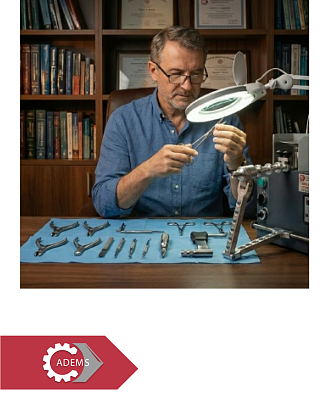
Microscope-level quality control
Edge geometry and surface roughness must be verified under magnification. Visual assessment alone is simply not acceptable here — the margin for error is zero.
Rigid fixation and exact angle calibration
Freehand sharpening — even by an experienced professional — introduces variation that is unacceptable in a clinical context. The instrument must be locked in position and the angle set mechanically.
Heat control
Overheating during sharpening destroys the temper of surgical steel. A single careless pass can render an expensive instrument permanently unusable.
Repeatability across instruments
In a clinical setting, the same result must be delivered every time — not occasionally. A system, not a skill, is what guarantees this.
3. The geometry challenge: curettes and scalers
Dental instruments — curettes and scalers in particular — present a specific geometric challenge that sets them apart from most other instruments.
Their working ends are curved, and sharpening must restore the cutting edge without altering the curvature radius or flattening any of the instrument's faces. This requires both the right abrasive and a controlled, stable sharpening motion. Any deviation changes the instrument's behaviour at the treatment site.
Common mistake: using a flat stone on a curved working end. The result looks sharp under normal light — but the curvature has shifted, and the instrument no longer performs as designed inside the periodontal pocket.
4. How ADEMS equipment meets medical-grade standards
4.1 Precision and repeatability
ADEMS machines are built around a core principle: the result must not depend on how experienced the operator is that day. Instrument fixation, angle setting, and abrasive pressure are all controlled mechanically — not by feel.
Full-featured platform for professional sharpening studios. Handles a wide range of medical instruments with consistent results.
ADEMS Med
Specialist models designed with medical instrument geometry in mind. Compact and precise.
Series
Versatile range suitable for both clinical facilities and independent sharpening professionals working with medical tools.
ADEMS ASAB System
Rapid abrasive change in seconds. Medical workflows often require multiple abrasive types across a single sharpening session — ASAB removes the bottleneck.
4.2 The ASAB abrasive system
Medical sharpening typically involves several stages: coarse material removal, fine edge refinement, and polishing. Each stage requires a different abrasive. The ADEMS ASAB quick-change system switches between wheels in seconds — keeping the workflow clean, fast, and consistent.
Sharpening medical instruments is precision manufacturing — not a service.
It carries direct responsibility for the safety of patients. Ignoring edge geometry standards, overheating the metal, or using the wrong abrasive turns an expensive surgical instrument into a source of risk. The equipment used must match the standard that medicine demands.
Who this applies to
If you manage a surgical centre, dental practice, or medical equipment maintenance service — understanding what proper instrument sharpening requires is part of your quality standard. And if you are a professional sharpener looking to add medical instruments to your offering, this is a high-value, underserved niche with very few qualified competitors.
Ready to work to medical-grade standards? Our specialists will help you identify the right equipment for your instruments and workflow.
Other ADEMS news
.png)
.png)
.png)
.png)
.png)
.png)
.png)
.png)